Brené Brown: Hi everyone, I’m Brené Brown, and this is Dare to Lead. And oh my God, I’m really excited because who’s with me? Introduce yourself.
Adam Grant: Adam Grant.
BB: Get ready, gear up. Adam Grant. Adam Grant is here. We are going to do a six-part series on Strong Ground, the new book, and I cannot wait to talk to Adam about it. I love the challenge. I love the questions. Always love his curiosity. I’m sure I will be thinking again in real time. So welcome to the pause-cast, because you know it takes me a while to do that. Adam, I’m so excited that you’re doing this with me. Thank you so much.
AG: Oh, the excitement is mutual, Brené. I thought it was interesting you said the book as opposed to my book.
BB: Oh, it feels like the book right now, because it feels like I’m stepping over boxes of them. I’m trying to figure out how to talk about it. I have a four-page note of everything I wish I would have put in it. So it feels like the book right now. But it is the book right now, Strong Ground.
AG: Everything you wish you would have put in it? There’s so much in it already. I mean, look, I don’t know if you can see here, but I’m a corner folder, and I folded more corners than not.
BB: It’s a chunky little thing, isn’t it?
AG: It’s incredibly rich. There’s no way we could do this in one episode. So I’m glad we’re doing six. I think we might need 12.
BB: I would do 12 episodes with you, Adam Grant.
AG: Well, be careful what you wish for.
BB: I am going to put it on my wish list. I’m closing my eyes, making my wish. All right, let’s jump in. I was really nervous about talking… Because we haven’t talked about it. And you’ve read the first chapter, gave me some notes on it. As you can see, I incorporated all of your notes except for one, because you said, is it really killing you? Is that hyperbole? And I was like, no, it’s hyperbole. I’m going to keep it.
AG: That’s fair. Sometimes I take things too literally. I have to tell you, so the first surprise for me was after I got past the intro, which I’d read before, I never thought there would be a tush push in a Brené Brown book ever. Did not see that coming. I’m like, wait, did you do that for me because we live in Philly and root for the Eagles?
BB: I’m a Birds fan.
AG: There we go.
BB: Let’s just talk about this right off the bat. I am not afraid of a sports metaphor.
AG: I’ve noticed.
BB: Yeah. And I even have to write a whole chapter letting people know why I’m using sports metaphors. And I will tell you that I’ve had some criticism in the past around using too many of them. And I took that criticism as you can use it, but you need to explain it, not they should go away. So I try to explain the sport. And I’ll do anything. I’ll talk about cricket. I’ll be on the pitch in Premier League. I’ll do volleyball. But I love a sports metaphor. How are you feeling about the sports metaphors?
AG: Well, I love them as a sports fan, but I also think they’re really applicable to the topic. And they’re fitting throughout the book because the book starts with you having a not so pleasant sports experience. So I feel like we should begin there.
BB: You want to start there? Go ahead. You ask me anything.
AG: Well, I was so surprised that a Brené Brown book on leadership started with you suffering with an athletic trainer.
BB: Yeah.
AG: And I want to hear more about that.
BB: Okay. So the whole idea of Strong Ground came from, and this is where people are going to be on board with this or it’s going to piss people off. I am a huge pickleball player. I play six times a week, two hours a day. I prioritize it with family time and connection. For me, it’s being in fit spiritual condition for me involves playing pickleball. And I think the reason is because I was an athlete. I grew up as a swimmer. Then I played tennis for 30 years. And I never thought that I would be this age playing a physical sport and feeling competitive again. Like training, drilling, having to go back into kind of the psychology of sport, which is one of my biggest barriers actually. And so it opens up with me talking about, it might even be my favorite first sentence of any book I’ve ever written, which is, let me see, writers should be required to apply for a permit if they want to use the word writhe because it’s such a good metaphorical word. Like I was writhing in uncertainty, but this story is, I was on the court.
BB: I was relatively new to pickleball. If you come from tennis, you’re going to suck for at least 10 to 12 games. I had been eyeing, I always like to play up, these people that were better than me. I would been eyeing these people that were better than me. And I was like, one day I’m going to get, they’re going to ask me to play one day. And they asked me to play. And I was, first serve, you know, 0,0, 2, first score. And I served and I don’t know what I did, but I could not get off the ground. I was incapacitated and in more pain, writhing pain, permit requested and granted, writhing pain. And it’s the story of healing from that injury. Hearing some really hard news that I was using that I had. Had you ever heard of that before? A compensatory injury?
AG: No.
BB: Yeah. I had a compensatory injury, meaning the big muscles, my core, were non-existent. So I was using inefficient muscle groups to compensate for no lats, no glutes, and no stomach muscles. And if I wanted to play competitively, I would have to build the right muscles and use them if I didn’t want to get hurt. And Tony, my trainer, is so hardcore. And the more he talked to me about agility and balance and mobility and stability and strength, not building on dysfunction, because I just wanted to get in there and move heavy shit because I’m a very competitive person. And he was like, no, we’re not going to do that. We’re not going to build on dysfunction. We’re going to figure out what’s going on. The more I just saw this metaphor unfolding of the work you and I both do. Organizations, no core. Leaders, no core, using inefficient muscle groups to lead, to build strategy, building on dysfunction, and getting hurt all the time. And so a metaphor was born along with my lats.
AG: It’s such a powerful one. And I mean, you’re right. As you unfold the story, I felt like reading it, you were describing workplaces. And like, wait, hold on a second. You’re talking about how to strengthen the human body. But what it takes to strengthen an organization, and in particular for leaders to be strong, is exactly the same.
BB: Isn’t that weird, though? Don’t you think it’s weird?
AG: Yeah, it was such an interesting and unexpected parallel. And it made me curious about, well, I feel like you should define strong ground and tell us what that looks like physically, but also socially, relationally.
BB: Well, it was interesting because I was, I can’t remember what exercise I was doing. There’s two. I really did. I always think about you because you were like an NCAA diver, right? And so I figure you got big lats. Like, you’re probably a lat guy. Like, my son is a water polo player, lat guy. I couldn’t find my lats. Like, I literally was doing this thing where you were holding something, you know, and pulling it down. And I’m like, this really hurts my neck and my shoulders. And he’s like, because you’re not supposed to be using those. Use your lats, Brown. And at some point he said, he looked at me, and the same thing was happening when I would throw a really heavy medicine ball against the wall. I’d say, God, this really hurts. And he’s like, you’re not using your core at all. And so one day he looked at me when I was doing my lat pull downs, and he said, find the ground. And I looked down at the floor, and he said, no, not the floor. The ground. Find your ground. And I love him, but he was kind of like being a dick in a way, because he was like, he was not relenting at all. And usually I can manipulate people to, you know, not do the exercises I don’t want to do and stuff. And so he was like, find the ground.
BB: So I kind of looked at the floor, and he said, push into it with your feet, all of your feet. Put, you know, feet hip distance apart. Bend your knees. Push into the ground. Find the ground. And then all of a sudden he said, use your body and your mind. And I was like, okay. So I just, I thought about, I told my brain to find my feet and then told my feet to find the ground. And I kind of, I guess, ended up in what, I guess what you would call an athletic stance. Is that what you would call it? You know, knees bent, pushing in to the ground. And then from there, all things became possible. And it was shocking to me. So my mantra at the gym became, strong ground, Brené. Actually Brown, because that’s what he calls me. Strong ground, Brown. Strong ground. And so I started using it. The first difficult conversation I had to have as a leader, I literally stood up before the person walked in my office and just said, strong ground.
BB: But I wasn’t finding my lats. I was trying to find my values. Like I was trying to dig into my values and work from a place of strength. And what was interesting, I don’t know if you’ve ever had this experience, is he said, I want you to stand like you normally stand when I ask you to do these exercises or throw the ball. And I was standing there and he took both of his hands and just pushed my shoulders and I fell backwards. And then he said, find your ground. I found the ground. He pushed and I didn’t move at all. And that’s how I want to lead. That’s how I want to stay above the line in my work. That’s how I want to be in my values. I want to be flexible and agile and mobile, but grounded. Does that make sense?
AG: Oh, it makes a ton of sense. And I’m glad you clarified that you were looking for your values because I was imagining you going into this difficult conversation in an athletic stance.
BB: Bring it. No. Yeah.
AG: Brace yourself.
BB: Brace yourself. Yeah. I’m going to push you against the wall. If you move, we’ve got a problem. No. No. Just, I was recently working with a college football team and they have four big values, you know, discipline, commitment, accountability. And I asked them what it would be, what it would mean for the team if everyone on the team was standing in athletic stance in those values every day in class, out of class, on the field. What does that mean? And one of the kids just looked up and said, unstoppable. You know, and so to me, strong ground, it started as building strength physically, but now I think it’s about spiritual, cognitive, and emotional strength for me.
AG: So let’s talk about then what it looks like to become grounded in your values. First of all, how do you figure out what your values are?
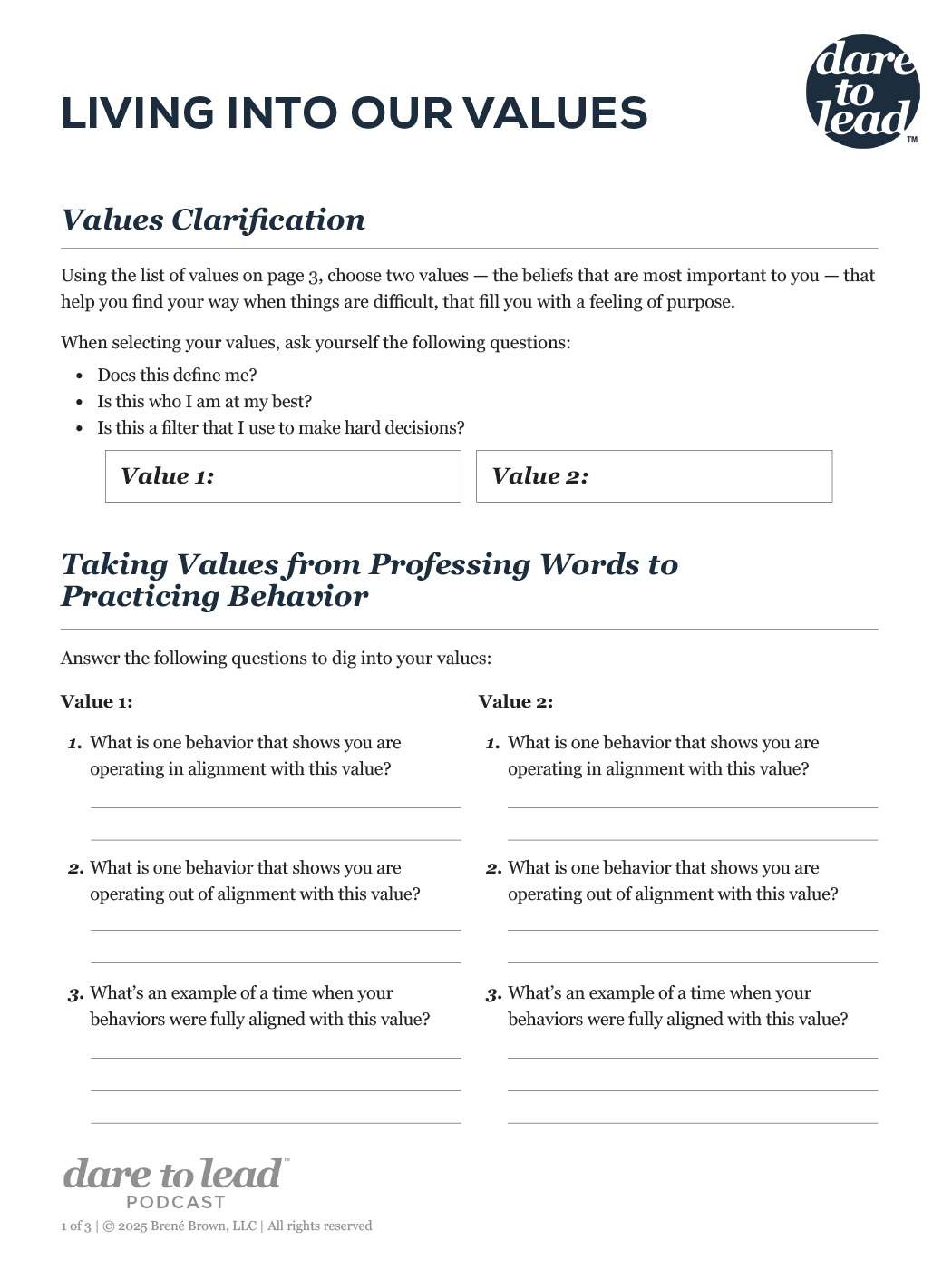
BB: We, I love the exercise we do in Dare to Lead Transformation. So we give people, it’s really interesting. We get… I can’t, I am dying to ask you about this. Okay. Yay. We give people a list of, I don’t know, maybe a hundred values. And we ask them to pick two because we reverse engineered that from our research and found that the majority of leaders that we’ve talked to can reference very quickly one or two key values. So people push back like crazy. They want 20 of them, you know, and then they feel bad if they don’t circle family as one, it’s like this whole thing and you can predict it every time. And so what I’ve started doing when I facilitate the work is I say circle up to 20. And then what are the two values where every single thing on this page that you’ve circled are forged? And it’s, it’s really emotional for people because they’ll say, I wanted family to be one of my two values, but really it’s integrity that allows me to choose my family over another late night of work or another weekend working. So we really, and then we start to operationalize them. Like what are the indicator lights that go off when you’re out of them?
BB: What does it feel like to be in them? Tell us a specific experience of when you were in it and what it felt like. What did your body feel like when you’re operating outside of it? So we do a really deep dive. I’m curious about this question for you. One of the big questions we get when we do this exercise is, are you talking about my personal values or my professional values? I operate from the belief you’ve got one set. What is your thought?
AG: I’m with you there. That question doesn’t compute for me.
BB: Say more.
AG: Your values are your guiding principles. They’re what matter to you. And I think the prioritization could change a little bit personally to professionally, but if you’re somebody who cares about excellence at work, you ought to care about excellence at home too. If you’re somebody who stands for integrity in your personal relationships, you ought to live by that in your professional relationships too. And the idea that we’re going to check our values at the office door or become a different person, we leave work, to me is failing to understand what it means to be grounded in a set of core principles.
BB: What do you think drives that question?
AG: Wait, hold on. Brené, who do you think is in charge of this conversation? What are you trying to do here?
BB: I mean, no shit, me.
AG: I’m asking the questions.
BB: No, but what do you think? Do you think it…
AG: No, I have more questions for you.
BB: No, do you think it’s… Do you think that one of the things that drives that question is people have a hard time integrating their guiding principles, a harder time at work than at home because they feel less agency?
AG: Oh, that’s interesting. I can see that. I can definitely see that being a challenge for a lot of people. I also, I think related to that, there’s the additional issue that many people are in jobs that stifle their values.
BB: Yeah, they can’t reconcile them.
AG: And might be incompatible with what they stand for in their personal lives, but they can’t get out. And so they feel trapped and unable to build a bridge between who I am and who I’m required to be in order to get a paycheck.
BB: It’s interesting because this comes up a lot around faith, and my two values are courage and faith. But while I am an extreme supporter of separation of church and state at all levels, I don’t have a hard time with my faith at work as a person who deeply believes in God for me, because it’s just how I treat people. It’s not what I espouse, which is actually how I express my faith outside of work as well. It’s not the words. It’s the deeds. It’s the action. But I can see how you’d have to do a really deep excavation of what those values mean to you in order to live by them in an environment that seems almost hostile to them.
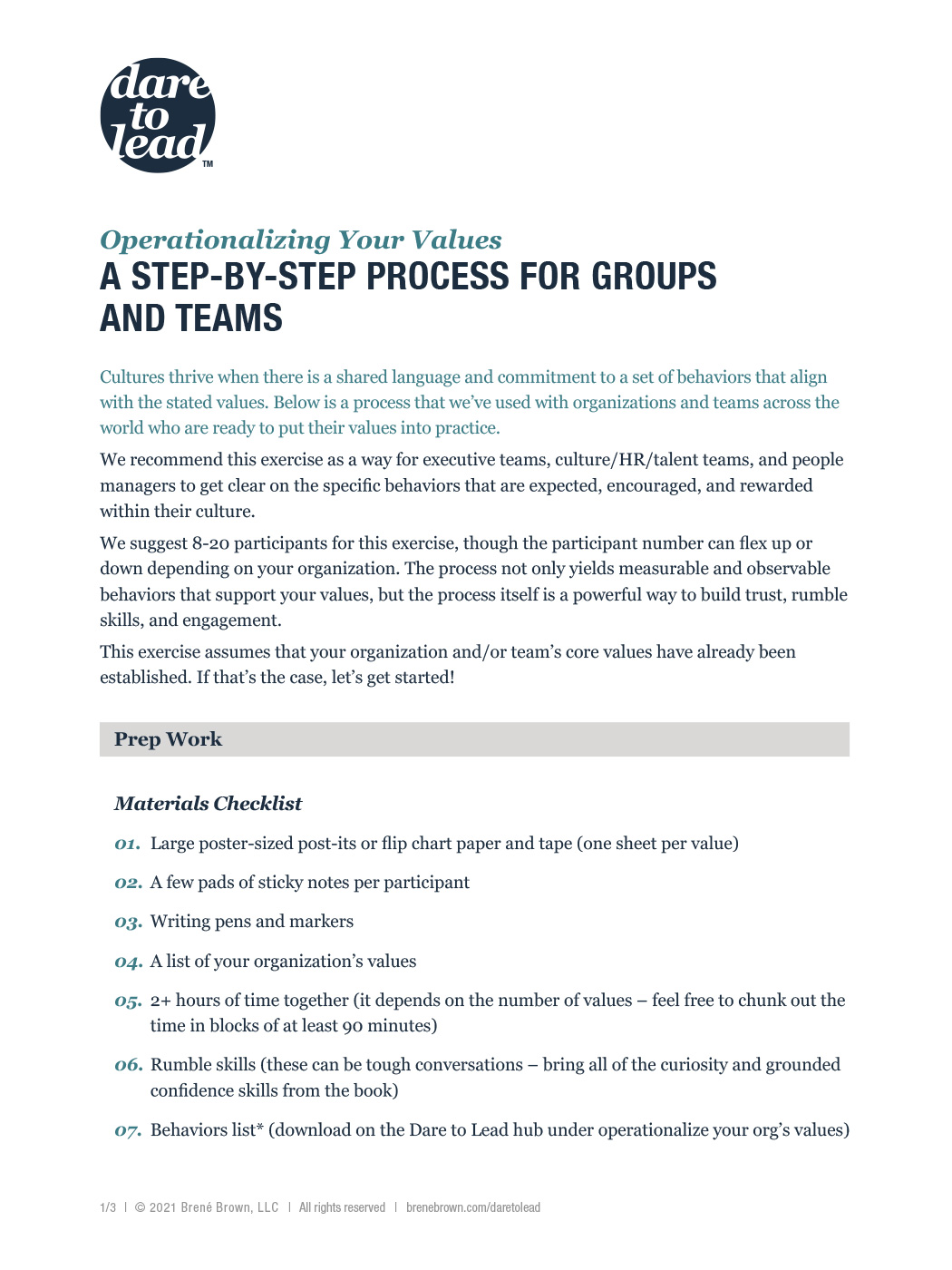
AG: Well, this is one of the things you point out in the book is a lot of organizations have values that are basically empty statements that get plastered on a wall and they haven’t mapped them to what are the valued behaviors? What does it look like to uphold these values? What does it look like to violate these values? And how do I know whether my own daily actions are basically failing or succeeding when it comes to adhering to our core principles? So, okay, so I have multiple questions for you on this. The first one is I’m struck by the fact that you’re really pushing people to limit their values. And two even goes farther than I typically have, which is to say, oh, my colleague Drew Carton led some research showing that if organizations had more than about three or four values, they tended to struggle more because people didn’t know what they all meant. They didn’t agree on how to define them. That took away from their ability to coordinate and get on the same page. And so I think the pruning exercise is really important. How did you get to two?
BB: We just reverse engineered it. So that was born out of the original study with 150 kind of high performance, strong culture leaders that we interviewed maybe 15 years ago. And when I just said, what are your values? Not a single one had more than two, and some had one.
AG: Wow.
BB: So, and then when we poked on it and we pulled into it and said, are you saying that these are the only guiding principles you need? The answer was yes, because everything else, this is the fire through which everything else is tested. And so we just reverse engineered it. And it’s interesting. Would you be surprised if I told you that about 10% of the organizations that I work in, and I’ve worked in hundreds at this point, about 10% of them have operationalized their values into behaviors that are observable and measurable?
AG: I’m surprised it’s even that many.
BB: Oh, my God. Are you really? So rare.
AG: Yeah. So rare. But I want to know what that looks like when you’ve seen it done successfully. So you start out with one or two core principles, and then what?
BB: At an organizational level, I don’t worry about four or five. Anything more than five is, you know, what I tell people is it’s better to have no organizational values than to have them and not have them operationalized. Because let’s say courage is a value that you… You know, and all you have is a soaring eagle poster, you know, that says courage underneath it. Like, I don’t even know what that means. But if I report to you and you’re like, hey, Brené, you’re late. Again, you’ve missed three meetings this week. And I said, you know what? I’m really being brave. And I know that’s an organizational value here. And I’m really trying to be courageous in my self-care. And I’ve got mani-pedis and, and facials scheduled in the morning. And I feel like I’m living heavily into our, you know, Grant Brown Corp values. Well, what do you know? And so what it looks like is a value… So, for example, in our organization here, one of our values is courage. How that’s operationalized is we talk to people. We do not talk about people. We create meetings where people can speak. We do not hold meetings after meetings.
BB: But something’s coming up for me. And I have seen this done well, actually, in organizations. But here’s what I think not leaders but kind of C-suite and C-suite direct reports get scared about. If you’re going to take the time to operationalize these values into observable, measurable behaviors, and you’re going to hold people accountable for them, are you willing to make them as important as KPIs and other performance metrics when it comes to firing people, holding them accountable, and their bonuses? So if you have a high performer who delivers a ton of revenue, but you’ve operationalized your values into behaviors, and this person is outside of the behaviors, are you willing to take the revenue hit to create a winning culture?
AG: I hope the answer is yes.
BB: But what do you think the answer is?
AG: I think you probably get a lot of people sort of hedging and saying, well, it depends how high the performance is. And, you know, can’t we try to reform the person first?
BB: Yeah, I think you can put the person in coaching and do that kind of stuff. But in the end, do you believe that you can drive performance and growth and come down very clearly that asshole behavior is not acceptable? And I think the answer is yes. I just don’t think leaders have the skills to do it.
AG: No, I don’t either. I think that so many leaders confuse being demanding with being demeaning.
BB: Oh, my God. Say that again.
AG: I wait, I don’t know if I can repeat it in the same words, but I do see a lot of leaders who think, okay, I have to be tough, I have to be hard-charging, I need to create accountability, and they cross the line from demanding to demeaning.
BB: Yeah, I mean, that’s exactly, that’s so beautifully put. That’s exactly right. And the thing about demeaning leadership behavior is, basically, I think, I’d be curious what you think, boiled down to its essence, to me, it’s about using fear to lead. And fear has a very short shelf life.
AG: So well put.
BB: You have got to get meaner and meaner. And we see that today.
AG: Because, wait, unpack that for me. Is the short shelf life because people can only stay in the intense state of fear for so long? Or is it because they adapt and you have to essentially intensify it in order to continue evoking the fear?
BB: I think what we see around the use of power over and fear as a leadership tool is that people do both. They adapt, and you can’t maintain that level of nervous system activity for that long. So in order to maintain power over as a leader, you need to engage in periodic bouts of cruelty to remind people what you’re capable of.
AG: Yeah, that tracks. Okay, so talk to me about what you do when you encounter a leader who operates that way, and you want to help them find their ground and shift. Where does that conversation begin? It sounds like it could be a rumble.
BB: I do. Would you like a rumble? I think for me, these happen in the context of a transformation. So I’m usually working pretty closely with the top senior leaders. And if they say to me, we have a person who a lot of people want to transfer out of his or her unit all the time, they’re using shame as a management tool, they’re high performing, then I’m a huge believer in coaching. I’ll be curious if you share that belief. I just feel like leaders are, they’re the only people in the world where high performance is expected, and a coach is not normative. I mean, could you imagine, like, could you imagine, like, putting your heart into, you know, the Eagles, and there’s no coach on the sideline? There’s no head coach, there’s no defense coach, there’s no offense, I mean, there’s no coach. And so I think coaching can be helpful. But I think the bottom line is, this is the hardest thing to change, if the senior leadership is not willing to hold people accountable. So I have a long conversation with those folks first and say, I don’t want to, this work is hard. It’s a slog. It’s personal for people. They got to do a lot of self-awareness work. They’ve got zero metacognition skills. Like, we’re going to have to jump into some very difficult work that’s going to become personal in about three minutes. And so if you’re telling me if the behavior doesn’t change, this person’s leaving, let’s go. If you’re telling me this person’s staying no matter what, they bring in a lot of money, it’d be nice if they changed, I’m not interested in helping. Just to be honest.
AG: Yeah, no, I’d rather not see you waste your time with people who are not willing to change.
BB: But I think it’s a vast minority of people. Because I can tell you that, let me see if I want to say this, if I think it’s true. In my experience, which is limited, but broad, I can’t think of a single time I’ve come across someone who leads from power over, who makes the move from demanding to demeaning, as you would say, whose life outside of work is great. They’re usually struggling with disrupted relationship with children, divorce or divorcing, or partner issues. Again, because you don’t check who you are at the door. And I don’t see people return to a life where they’re prioritizing humanity and love and connection and belonging after five o’clock. I just don’t see that. So a lot of times people lead that way because it’s the only skill set they have. That’s the only tools they have.
AG: Yep, I can, as you’re describing this, think of specific leaders that I’ve worked with, that I’ve observed, who didn’t necessarily start out that way in their personal lives, but adopted the management by fear and shame as the, it’s the only way to get the results I want. And I look at that and think you are rationalizing aggression and using it as an excuse. When, in fact, there are always multiple paths to the same end. And as you engage in that behavior more and more, it becomes more central to who you are. And you can’t shed it when you leave work. And it starts to come home with you.
BB: I think that’s true, and I think maybe the heart of Strong Ground for me is the idea that driving growth and performance and leading from a wholehearted place not mutually exclusive but highly skilled work. Like, when you see leaders that can do that, who can really get important and strategic work done, mission-critical work done, and they have a team of people who care about each other and trust and respect each other, you are going to peel back an enormous skill set.
AG: Well, this speaks to one of my favorite parts of the book. So I’m going to quote you to you. I have to read this. I loved it so much. This is from page 21. You say, The false dichotomy persists that leaders can either invest in training and coaching specifically developed to increase performance, revenue, and growth, or they can invest in culture initiatives and coaching that result in more courageous, connected, and collaborative human beings. If this feels like your ROI dilemma, I suggest you back away slowly from the quarter-zipped consultant with the 200-slide deck. Fully alive, well-supported, and connected human beings are unstoppable. Bam! Mic drop.
BB: Okay. I could have hit it too hard on the quarter-zip comment, but…
AG: It was exactly the dose of sarcasm needed.
BB: Oh, I know the quarter-zips because I’m always jockeying for position with them in the 1K line for United. You know, it’s… This is the whole part. Like, the subtitle of the book, The Lessons of Daring Leadership, The Tenacity of Paradox, and The Wisdom of the Human Spirit. Well-respected, seen, heard, believed, well-connected human beings in an organization is the organization’s strong ground. That is both your stabilizing force in an organization and the platform from which you can have explosive change, behavior, and adaptability. And I’m not Chicken Little when it comes to technology. Like, I engage with all of it. I think there’s some stuff that’s great about AI, some things that are dangerous. It’s like everything else. It’s like fire. You can use it to stay alive and stay warm, or you can burn down the barn. You know, it just depends on the human application of it, right?
BB: But moving forward, the ability to straddle the tension of paradox and resolve that tension with a completely different solution that’s presented in the paradox is the way forward in leadership in my mind. It’s not performance or culture. It’s what do we need to build to straddle that tension that leaves us with performance and culture. It’s not growth or caring. It’s growth and caring. What do we need to do to straddle that paradox? And so when I started trying to uncover what kind of the knowledge, self-awareness, skill sets were that allowed people to do those things, I was… I mean, you’re one of the teachers in the book. There’s five teachers in the book that, you know, whose work needed… It needed your picture in the book because it’s more than just a quoted paragraph or, you know, a couple of quotes. It’s like your ideas, Dan Pink’s, Sarah Lewis, Aiko Bethea, Virginia Clarke. I mean, these are central to my thinking in this. These are hard skills to develop. We do it in people, but it takes two years.
AG: So what do I do if I’m working under leaders who don’t get it? So one of the things I kept thinking about in the earlier parts of the book is, yes, I’m on board with this, but there’s not support above me. Like, if I can, I’m going to go find another place to work. If I can’t, how do I survive?
BB: One of the biggest lessons that I’ve taken away from doing this work… You know, we just kind of passed the, I think, 160,000 people we’ve taken through Dare to Lead transformations in maybe 45 countries, is if you have the responsibility and gift of leading a team, this is going to be amazing for not just you, but for the people that you serve as a leader. If you’re an individual on a team that’s not doing this work, that doesn’t have a leader on board, this work will still make a huge difference in your life and how you show up and how you go home and how you wake up and how you think about your work. And in our experience, when you start putting these things into practice, you will eventually be leading. Because to be able to demonstrate that I can get good strategic work done that’s critical to our success and build a team around me that cares for each other and trusts each other, you may not be a leader there, but you will be a leader.
AG: I think that’s such a key point because even for senior leaders, it’s very difficult to change the culture of a whole organization overnight. But we can all move the values and norms of the teams we’re on.
BB: I mean, that’s it.
AG: We all have local impact.
BB: We all have local impact. And what’s interesting is if I’m sitting down with the CEO and they’re like, you know, we’re really thinking about this investment of a Dare to Lead transformation. What do I need to know that’s scary? I’ll say I’m looking for a critical mass of individual people excited about doing hard work, having brave conversations and being good, trustworthy people. I just need a critical mass of individuals. I don’t need everyone to come along and I’m not interested in everyone coming along. So if you need everyone to come along, this will be a difficult transformation because you will lose 30% of your people.
AG: This reminds me of some research by Damon Santola suggesting that you only need about a quarter of people to be on board with a change in order to build momentum behind it.
BB: That’s true.
AG: And so critical mass is not as many people as I once thought it was. It’s not three quarters. It’s not half.
BB: No, it’s not. And it’s because it’s especially… I think about another sports analogy, which actually did not work for me. But the first time I did a triathlon, they said, you know, all you need to do is to be able to finish two thirds of each part before you go to the race because the momentum of the race will carry you. Now, that could have been true, but I trained in Houston and the triathlon was in Austin in the hills. I didn’t even have multiple speeds on my bike. I had a bike like with a frickin basket. But I do think some of that principle works that like you don’t probably need, I’d be curious to dig into that research more. You probably don’t need as many people because change is a unit in the relationship itself. It carries a lot of momentum, especially if you’re moving towards something great.
AG: I’d love to hear how you’ve operationalized your values in your life. So you told us that your two are courage and faith. And you gave us a little bit of a taste of faith being about deeds, not words. What are the key behaviors for you for both of those values?
BB: I think the place where they come together and create like just, again, the biggest kind of super cycle for me is choosing to do what I believe is right and choosing to be brave over being comfortable. And I don’t think when I don’t think you have to really pervert and bend faith if you’re for me, if you’re a faith driven person to have a life of comfort, because you’re constantly challenging yourself around. And I think that’s being courageous, too. And so I think when I’m really operating highly in my values, I, one, try to think of leadership as service and two. I try and accept the fact that discomfort and being liked is not as important as being aligned with my values. Can I ask what your values are?
AG: I’m having a hard time boiling it down to two. I was going to say I wanted three, but before I answer that, let me just follow up and ask you, so if feeling uncomfortable is part of you knowing that you’re aligned with your values, is comfort then ever… Well, let me ask this a little differently, actually. You can’t be uncomfortable all the time. And there’s a form of comfort that signals to you, I’m actually living by my values. What’s the difference between good and bad discomfort and good and bad comfort? Or maybe good and bad are too evaluative. Maybe aligned comfort versus misaligned comfort, and the same for discomfort. Because I’ve had a hard time parsing between those, personally.
BB: So I think this is a really great, a really important question. When I’m out of alignment with my values, the discomfort shows up as resentment for me. Resentment and under the line fear-based behavior. When I am being uncomfortable and brave, it’s a very embodied feeling. And there’s a lot of discipline and humility involved in it, for me. So when I get big and boisterous and fake brave, an alarm goes off for me. When I’m kind of quiet, humility, and discipline, just do the next right thing, even if it’s small. And then for me, what it feels like when I do that is not comfort. And this is a word that’s not very popular, but I think it’s underestimated. I feel a very strong sense of contentment. Like, I’m at peace. Like, nothing’s… You know the sound of a car door that slams when it’s like a good, heavy, 1979 Buick, and the door slams, and it’s like, Like, I feel like that, as opposed to like a scrappy, halfway-closed door. Like, I feel solid.
AG: And you can have that with discomfort?
BB: I can. I can have… Well, the discipline for me is the me right now choosing courage or faith and discomfort as a commitment to the me in an hour who will feel content and whole. And so I don’t live in discomfort, but I’m willing to be in it to do what I think is the right thing.
AG: What does an example look like? I just want to bring this to life.
BB: Setting a boundary. I set a lot of boundaries all the time. I think I was in a collection of meetings that were really hard to schedule, and in the meetings, a couple of the principals were in and out for two hours. They probably were in and out four times. And I just said, the last time they came back, I said, I appreciate all the demands on everyone’s time. I think if we’re going to schedule a meeting, my expectation is that everyone is here and focused on the meeting and not leaving three or four times in the meeting for 10 and 15 minute breaks. I don’t think it makes for cohesive ideation, and it feels disrespectful of my time.
AG: Wow. A little uncomfortable, but clearly anchored to being courageous.
BB: Yeah, and I’m not going to get in the car and talk shit about them to other people and build up resentment.
AG: No, we can talk shit about them on Dare to Lead.
BB: No, I’m not.
AG: Without attribution.
BB: Without attribution, yeah. I’m just going to ask for what I need, and if that feels unreasonable, that’s okay. I’m just not going to schedule a two-hour block of my time because my time is equally as valuable. So I think that’s a real example, and I think that’s in my personal life and my professional life all the time. Like, I’m sober. I’ve been sober for 28 years. Most of my friends know that. Every now and then a new person will come around and say, oh, you know, I’ll bring the wine or a bottle of booze or something, and I’ll say, that’s great. Just know that, and I’m happy for you to do that. I won’t be comfortable if you leave my house after you’ve been drinking. So if you want to come and have some wine or, you know, so much so that you shouldn’t be driving, it would be great if you could ride share. Like, that’s just…
AG: Love it.
BB: Yeah, that’s just me, you know? And, yeah, but I’m not going to let you escape. What do you think your values are?
AG: Well, I was coming up with generosity, excellence, integrity.
BB: God, that just rings true for me when I think of you.
AG: Thank you. I hope to live up to that one day, but I failed your test of reducing to two, and then I thought, okay, do I drop excellence because that’s in service of integrity and doing things as well as I can. It’s part of following through on my commitments, or do I drop integrity and say that’s part of how I pursue excellence? Help me.
BB: Which one’s the fire? If you looked at those three and had to pick two that were the birthplace of all of them, I think generosity seems to stand on its own. You seem to not be struggling with that, and that’s a word I think of you. I mean, I see you like that. I think the question becomes, with integrity and excellence, if you’re outside of your integrity, how does that feel in your body? If you deliver something that’s not excellent, how does that feel in your body?
AG: About equally bad.
BB: About equally bad? And what would you…?
AG: I think integrity violations are rarer, but they hurt more.
BB: Interesting. Then I think it comes down to kind of the birthplace question. Is there one in service of the other? Is excellence part of a collection of behaviors that define integrity for you? It becomes hierarchical for me in a way. Does that make sense?
AG: Yeah. Yeah, I think that’s how I think about it. Yeah, excellence is part of the foundation of having integrity for me. That’s clarifying. I didn’t know I was getting coaching as part of this series of conversations. This is a bonus.
BB: I’ll send you a bill.
AG: Please do.
BB: Please. Yeah, I’d be really curious. I’d probably have you draw out integrity and the collection of behaviors or even commitments that you would make to yourself and to the world to be in your integrity, and I’d have you draw out excellence, and I think in defining those with properties and categories, you would come to an answer pretty quickly.
AG: Yeah, I think that’s right. When I think about it just in real time, I think, okay, the easy part of integrity is no lying, cheating, stealing. The harder part is what are the commitments that are non-negotiable to follow through on and which ones are more flexible.
BB: That’s interesting. That’s hard. Yeah, because…
AG: That is hard.
BB: Because when I think about you, the other word that comes up for me, and I don’t know where it fits, is you are, to me, if I think about one of the words that describes you is disciplined. And I’d be so curious if discipline is part of integrity for you.
AG: I think it is. I think otherwise… Yeah, I think… Yeah, it’s interesting. I feel like I have to work on being more undisciplined deliberately to make sure that I’m putting myself in uncomfortable situations and that I’m also not getting stuck in a sort of linear, do-things-the-way-I’ve-always-done-them, repeat-what’s-working version of life.
BB: More to explore. That’s interesting.
AG: Well, I want to… We have a nice cliffhanger here, but I do want to ask you, just looping this back to you, I felt a tension in the early parts of the book, and then I realized, oh, this is one of the paradoxes you’re writing about that I’m supposed to get better at accepting and living with as opposed to wanting to solve. But I feel there’s a tension between adopting a set of routines to make sure that you have your strong ground and also being willing to break your routines so that you don’t get trapped in the past. And I just wondered, I wondered as I was reading early on, how do you think about navigating that paradox?
BB: I think… Are you familiar with the Buddha’s concept of near enemy?
AG: I’ve heard you talk about it, but I don’t think I understand it well enough. There are near and far enemies. I know that.
BB: Right, so you would say that if compassion is the virtue, the far enemy is indifference, but the near enemy, the thing that kind of masquerades around like compassion but is actually dangerous, would be pity, right?
AG: Oh, that’s good.
BB: Right, and so I would think that…
AG: That’s very good.
BB: Yeah, so pity, and I think the same could be true. The virtue might be empathy. The far enemy is not caring about someone at all, but the near enemy to empathy is sympathy. Not feeling with someone, but feeling sorry for them, because that puts you in a place of superiority, right? When you talk about this paradox that you’re talking about, sometimes the near enemy concept… The Buddhist frame of near enemy really helps me because I think the near enemy of discipline is rigidity.
AG: Yes. Yes. Nailed it.
BB: I think rigidity masquerades as discipline. But what you would find in the near enemy column is kind of ego protection stuff and discomfort protection. So I think discipline… When discipline fails to deliver agility and the capacity to reflect and change, it’s no longer discipline.
AG: Oh, I love this. Okay, so this is making sense out of… I have a colleague who’s a very serious athlete, and I was… I don’t know if I was appalled or just shell-shocked to find out that he had a rule that there was no noise allowed in his house after 8:00 p.m. That’s how you think you have to be in order to be an elite athlete? No. And he thought he was being disciplined. I think you’ve just reframed that as rigidity.
BB: Yeah, I think that’s rigidity, and I think that’s… I don’t think that’s discipline because I think discipline would mean, especially if you’ve got kids in the house, I think discipline would be I need to develop a practice that increases my focus or increases whatever I’m trying to do after 8 o’clock that allows the human beings around me to be human beings. That’s discipline. Yeah. When you start to control the environment in order to protect yourself, that becomes rigidity.
AG: So well put.
BB: Yeah, and this is… I think this level of thinking, which is very new to me, like I just didn’t… It’s very new to me, and I needed a frame for it, which I think the near and close enemy frame was really helpful for me, but I think this is… And I’ve thought a lot about discipline, and I write a lot about it in the book because I had this interesting conversation with Rog Bennett, who heads up the Men in Blazers podcast, which is really the soccer, football, whatever you want to call it, Premier League podcast, and he knows I’m a big Liverpool fan, and so we did an interview on courage and discipline after Liverpool won the Premier League, and he asked me if I thought Arne Slot was an ego-less coach, and I really had to think about that question, and I said, no, he’s just disciplined in his humility, and to me, that’s really… The discipline thing has really been an unlock for me.
AG: That was one of my folded corner… One of my many folded corner pages, the idea that a coach who’s incredibly ambitious but seems to be all about a team could still have an ego and just keep it in check or invest it in the right things.
BB: Yeah. I mean, it’s disciplined humility. It’s just like no one’s fearless. I mean, if you’re fearless, you’re dead, basically. Fear serves an important purpose, right? But people can be disciplined in their courage, disciplined in their daring, you know, and so I think we underestimate discipline because we see none of it in the culture today. Very little. Some individual great examples, but in the zeitgeist, it’s not… Discipline and accountability are not popular right now.
AG: Well, that is a great segue to our next conversation. I can’t wait.
BB: Adam Grant, thank you for your generosity.
AG: Are you kidding? This is such a treat for me to get to do this.
BB: Next session. I can’t wait. Dare to Lead is produced by Brené Brown Education and Research Group. Music is by The Suffers. Get new episodes as soon as they’re published by following Dare to Lead on your favorite podcast app. We are part of the Vox Media Podcast Network. Discover more award-winning shows at podcasts.voxmedia.com.
© 2025 Brené Brown Education and Research Group, LLC. All rights reserved.